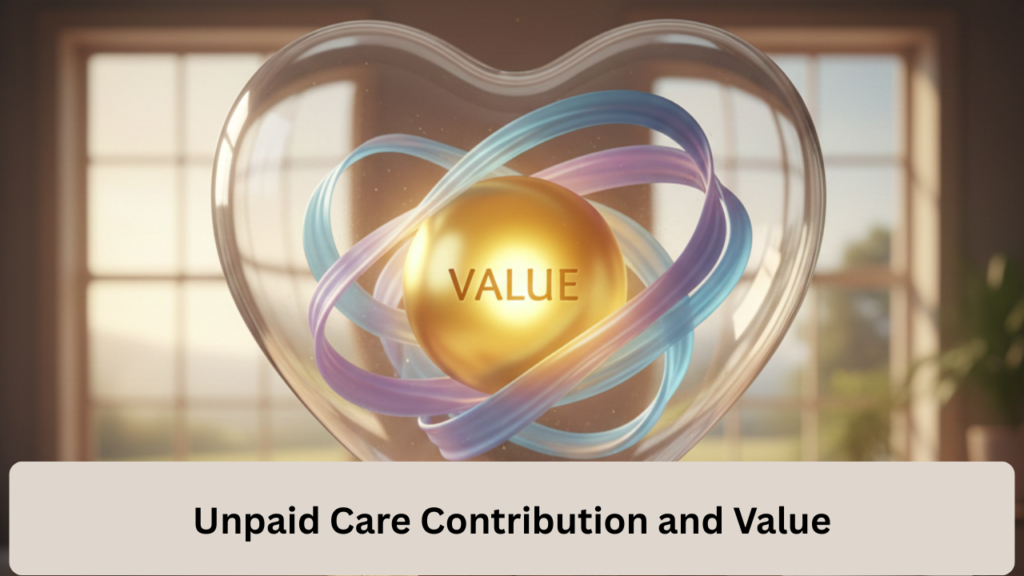
Bahasviral.com – Unpaid Care Contribution and Value. Suppose it was a city where all parents are at home on a day, everyone who takes care of some aged relative has a day off, and all food not cooked properly. It would not be just a series of silent households; the whole formal economy would collapse and stagnate.
It would have no more people in offices and factories and the entire rhythm of civilization would derailed. The bald and ugly reality on the unpaid labor of care is nonetheless that it is the silent, invisible cog that makes our world operate. The shoulders of our whole economy unrecognized.
Care work is most significant in our everyday life and is unpaid. It consists of waking up early in the mornings to breastfeed a baby, preparing a meal to a ill parent with concern, laundry and cleaning everything and keeping a family united emotionally. However, in the pages of our economy, our Gross Domestic Product, this work is nothing. It is a giant economic blind spot, and it is time to shine this significant job.
The Economic Value of Unpaid Care
Unpaid care work the work that done making care of a home and a community, only to have no form of payment. It has: Direct care also covers feeding, bathing, and educating children, medical care and companionship to the elderly and disabled. Indirect Care: Grocery shopping, cooking, cleaning, family schedule monitoring, and in most regions of the world the laborious and strenuous task of purchasing water and firewood makes up the logistics of life.
It is not a gender-neutral job. The women do about three-quarters of the work all around the globe. On average, women work 3.2 times more hours on unpaid care compared to men. This does not occur naturally, but it a social construction with highly significant consequences and often referred to as the care penalty.
Social and Emotional Importance of Care Work
But how can this have economic value when it does not pay? You will get the answer by a mere thought experiment: How much would cost to replace it? Economists use time-use surveys to assess how people spend time and estimate its monetary value if done professionally. The results are amazing. According to the International Labour Organization (ILO) unpaid care work perhaps has a value reported as high as 9% of the world GDP.
Which is basically equal to the total manufacturing sector of the global economy. A billion dollars a year of free labor, that. This forms a disagreeable paradox. This is the only work that makes our formal and market-based economy function without pay. A worker will only be effective in an office since someone is attending to the home, bringing up the next generation, and taking care of the last one. We are basing our economic policy on a lie when we do not put this contribution into consideration.
- The Human Cost: Something Better than the Numbers.
The impacts of this invisibility are much further than numerical. It transforms lives and does not allow people to achieve their potential. - Many women face a “second shift,” balancing paid jobs with unpaid household duties, causing stress, fatigue, and limited personal time.
- The Ambition Tax: Gender inequality is in large part due to unequal allocation of care work. It causes women to work on a part-time basis, reduces their career progression, contributes to the gender pay gap and imposes a motherhood penalty on them, decreasing their lifetime earnings and pension saving.
- The Thing That Keeps Us Together: you are only talking about the cost, you are not feeling its richness. It is this work that makes us human. Reading to a child over an extended period of time is beneficial to the child as it provides emotional assurance to his brain. Caring about an ageing parent by an adult child is a show of love that sustains their self-respect. Such acts of caring bring about social relationships and close communities which a business deal would never create.
Gender Inequality and the Care Burden
The initial one is to acknowledge the problem. The second to follow is to ensure the system is more equitable. A powerful change framework is the so-called 3 R’s Recognize, Reduce, and Redistribute.
- RECOGNIZE: The Unseen and Brought to Light.
The first thing we must do is to count this work officially. The governments should put unpaid caregiving labor in national economic statistics through time-use surveys. When we measure something, we are demonstrating that it is significant. Public awareness campaigns can shift the culture of care toward viewing it as a public good benefiting everyone equally. - REDUCE: make it more easy to carry.
Care work can be less tedious and time-consuming with the help of smart investments and technology. This means: Infrastructure: Making people availed of clean energy, running water, and low-cost transport, which reduces the amount of time they need to devote to tasks about the house significantly. Public Services: Investing in cheap and quality childcare and eldercare centers. This is not a social cost, it investment freedom of economic suppression. - REDISTRIBUTE: Divide and Ruleed.
This is the biggest change. Each person has to take care of others, at home and in society. Policies such as use it or lose it within families Paternity leave helps men to take care of their children since childhood and this is a reversal of the gender norms. We should challenge the notion that a father is babysitting and a mother is parenting. It is time to not think that care is a personal family affair.
Conclusion
Unpaid care work is the invisible, but a crucial pillar of society and the world economy. It works on maintenance of families, breeding of the future generations, and well being of communities, but it not recognized and appreciated much. It is important both to recognize its role in ensuring gender equality as well as to ensure inclusive and sustainable development.
The governments, private and communities should collaborate to identify, mitigate and redistribute the unpaid nurture roles with the help of enabling policies, infrastructure, and culture transformation. Appreciating unpaid care labor is one thing, which is appreciating human life, taking care that everyone of any gender gets the chance to do work, prosper and equally enjoys the fruits of development.