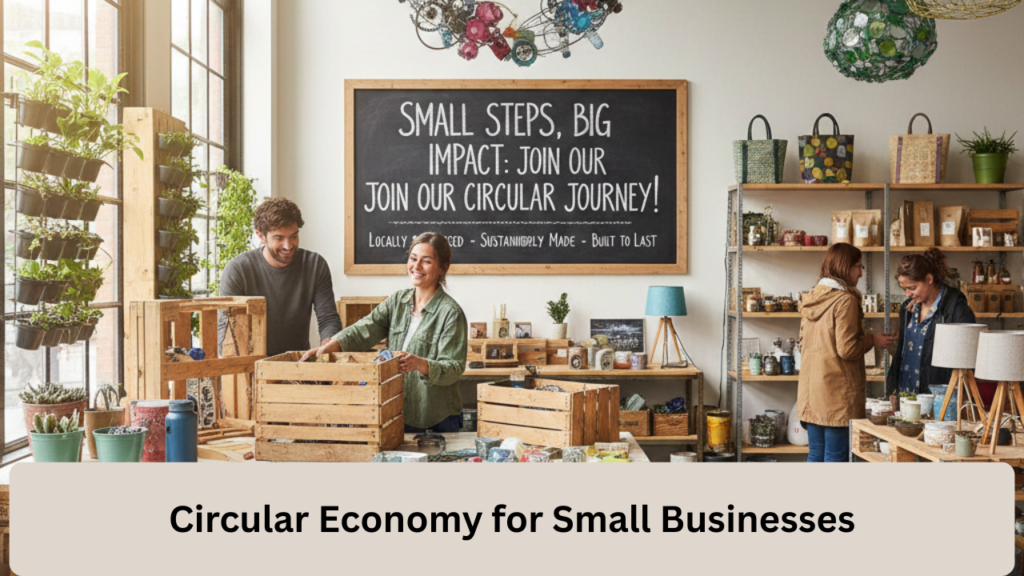
Circular Economy for Small Businesses. Sustainability is not considered a minor issue anymore, as it a major strategy for long-term success in the modern business environment. This transformation presents both challenges and opportunities for small businesses, in particular. Although it might be difficult to implement sustainable principles where there are limited resources, the idea of the circular economy an excellent opportunity to reduce wastage, increase efficiency, and build resiliency.
The concepts of the circular economy are applicable to small businesses in various forms, such as earning more money, retaining clients, and securing a competitive advantage. The circular economy will be contrary to the previous system of doing business, which was to take-make-dispose. It discourages the idea of treating goods and services as throwaway products; instead, it encourages the production of durable goods and services, reuse, and recycling.
This shift might appear large to the small companies, and even minor steps can cause major changes. Small businesses can reduce expenses, impact the environment less, and seek new methods of generating revenue by reconsidering the materials they utilize, the procedures they adopt, and the manner in which they engage the customers.
What is the meaning of the term “circular economy”?
The circular economy is a business model that is concerned with the wise utilization of resources, reduction of waste products, and handling of the lifecycle of products. Circular economy is contrasted with the conventional linear economy of taking, making, and disposing. Rather, it aims at ensuring that materials and goods are put use as long as possible.
This involves the preparation of things that are durable, repairable, and recyclable. It also involves creating systems that allow individuals to reuse, repair, or recycle items once they finished using them. To small firms, this form of operation may entail alteration of the supply mode, manufacturing process, inventory management, and communication with customers. Circular methods allow small businesses to reduce their costs, impact the environment less, and even increase.
Their profits are through product-as-a-service or recycling programs. Among the greatest benefits of a circular economy approach towards small businesses are efficiency and resilience. There is an opportunity to reduce reliance on raw materials that change their prices and accessibility in order to reduce their dependence on these materials. To illustrate this, such things as renovating old items or reusing them within the company can save on costs of procurement.
The reason why it should matter to Small Businesses.
Small firms are particularly useful in ideas of the circular economy. They tend to be more malleable as compared to big businesses, and this allows them to experiment with new approaches to things and ecologically friendly practices without getting entangled red tape.
It is also more likely that customers prefer companies that are friendly to the environment and the small businesses can use the trend to outshine in the saturated markets. Applying the concept of a circular economy can also help you to be financially stable. By consuming fewer raw materials, businesses can cushion themselves against fluctuations in prices and issues such as difficulties within the supply chain.
To give an illustration, renovating or reusing the materials within the company reduces the price of purchasing new materials and it is less probable that they would exhausted. In the long run, the gains can translate into massive cost savings and market competitiveness.
Longevity/Reuse Design: Significant Measures to a Circular Economy.
It is one of the most significant facts about a circular economy: to make things that work out longer and can repaired or repurposed. Small enterprises are capable of using good-quality, modular materials and designs, which can repaired to produce goods with a longer life. An example would be in the case of a small furniture store, which could sell modular components that consumers can upgrade, rather than get a replacement, or they could sell repair kits to ensure their products do not wear out as easily.
Begin to recycle and upcycle.
Recycling is a valuable aspect of the circular practices, yet upcycling, in other words, using trash to make something useful, may be even better. Minor companies may identify the waste materials in their business and invent innovative methods on how to use them to produce goods that consumers will purchase. One example is that a local cafe would use coffee grounds to create compost or skincare products. This would offer them a new method of earning money as well as reducing waste.
Apply Product-as-a-Service Models.
It will be worthwhile to transition to a service-based paradigm in lieu of the product-based one to maximize your resources. Under the product-as-a-service model, customers are paying for the utility of a product as opposed to owning it wholly. In the case of small enterprises, it can involve renting tools, providing people with access to tools at a fee, or maintenance work. This approach can used to make products last longer, minimize unnecessary use, and generate income on a frequent basis.
Enhance supply chains.
One of the ideas of the circular economy that can applied by small firms that these firms need to collaborate closely with their suppliers to reduce waste and identify other sources of materials. It could include selecting recycled or sustainably sourced materials, arranging a used item return program or product pooling to reduce transit-related emissions. Circular supply chain is environmentally friendly and can also enable you to have more resilient and deeper relationships with your suppliers.
Train Customers and create Awareness.
Circular projects to work on must engage people. Small companies must tell the truth and be frank about the advantages of applying sustainable practices. The customers should be more inclined to participate in circular activities when you emphasize the eco-friendly nature of your products, encourage recycling initiatives, and provide incentives to deliver used products. Educated and engaged customers normally turn into ardent followers, which increases the impact of the business on the environment to an even greater extent.
Conclusion
Circular economy can enable small firms to think long-term, be resilient, and come up with new ideas. The advantages of making things that last, promoting recycling and upcycling, exploring product-as-a-service options, supply chain optimization, and involving customers are potentially beneficial to the environment and bottom line of small businesses.
In a world where resources are scarce and consumers are getting increasingly conscious, small businesses that adhere to the ideas of the circular economy position themselves as not merely good corporate citizens but as versatile and adaptive market leaders as well. Sustainability is not a decision anymore but a factor of staying on top of the competition. In the case of small businesses, the circular economy is an effective, lucrative, and ethical means of proceeding.
Concisely, circular economy concepts can help small firms to be more strategic, resilient, and innovative. Small enterprises can contribute to the environment and earn money through the lens of longevity, recycling, upcycling, service, service-based business, efficient supply chains, and customer relations. In a world where resources limited and consumers are increasingly conscious of their decisions, the companies that apply the circular approaches emerge as good corporate citizens.