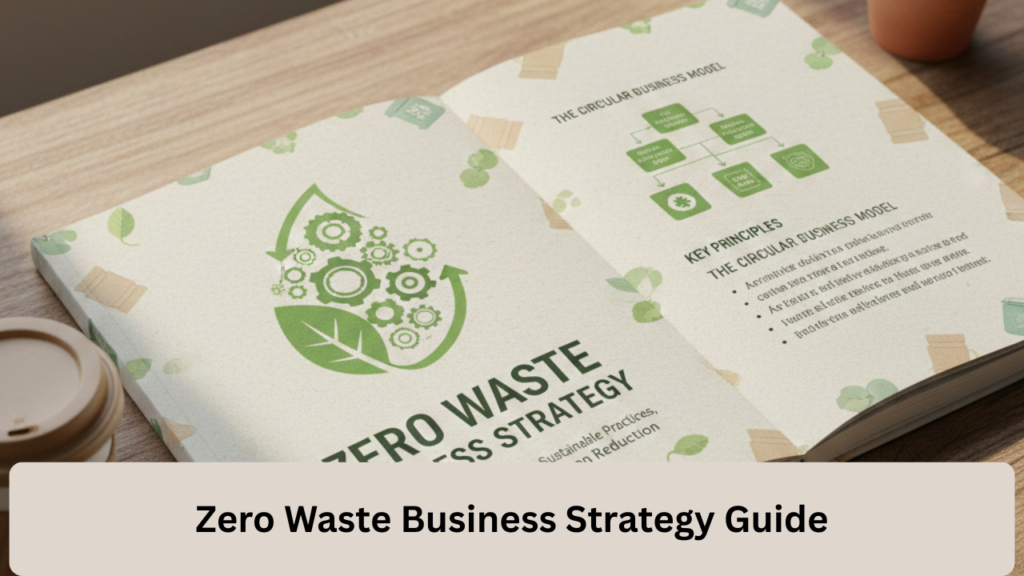
Zero Waste Business Strategy Guide. Environmental impact is no longer a mere footnote in the annual report of a company but it is a huge constituent of who they are. Citizens are voting with their dollars, investors are seeking companies that are green, and an emerging generation of employees seeks to be employed companies that support their ideologies.
At the heart of this transformation, there is a trend of zero-waste business. It is not only the number of fewer plastic bottles read or recycled. It alters how a firm operates in a significant manner, transforming the notion of waste as an inevitable expense into a design issue. And this approach is becoming a surprisingly inexpensive way of becoming innovative, efficient, and connected, rather than a very expensive overhead.
What is a Zero Waste Business Strategy?
Fundamentally, a zero-waste plan is concerned with the creation of such a system, which would not allow anything to go to waste. Imagine a forest: the leaves fall and are decomposed and nourish the earth so that new plants grow. There is no garbage dump. This simple and circular method is what a zero-waste company desires to duplicate.
Rather than the traditional take-make-dispose model, it establishes systems which materials safely reused, recycled, or put to additional uses, or composted back into the ecosystem. It is a holistic approach to business that captures every segment of the business.
It is in the selection of the raw materials, the effectiveness of the production line, the innovative design of the packaging, and the fate of the product after it manufactured. Rather than posing the question of how do we get rid of this? it questions Why did this make them be thrown away the first place?”
Why Businesses Should Adopt a Zero Waste Strategy
A good combination of ethical and economic motivation makes individuals become zero waste. The Bottom Line Booster: Waste is money that you squander away. It is actually the price of the raw materials you purchased but were not able to use, the energy expended on them, and the price of disposing of them.
Through good waste identification and control, companies are able to save a lot of cost. As an illustration, a food company may use rotting fruit, or a brewery may turn unused grain into animal feed, and what was previously a cost centre into a possible source of income.
The Trust Builder:
Authenticity may be a major distinction in a competitive marketplace. A recent survey by Nielsen (2023) found that the majority of consumers across the world prefer to pay a higher price on the products of companies that are environmentally responsible. Being a real zero waste proponent is not only a way to make a business shine, but also makes the customers loyal and trustful. This strategy appeals to the customers who consider their purchases as the continuation of their personal values and principles.
The Innovation Catalyst:
Limitations create creativeness in individuals. When a corporation vows to dispose of rubbish, it prompts them to rethink their mode of doing business in a massive manner. It may result in large-scale new thinking, such as creating new materials that can composted, coming up with new forms of goods that can easily disassembled and repaired, or devising new uses of things that used to considered waste.
The Journey to Zero: A plan with Steps.
A transition to the zero-waste strategy is not a race. You have to be patient: go on and have a plan.
The Audit:
Become a Waste Detective. You cannot be sure of something you do not look into. Waste audit is the most important step that needs to done first. It is not a glamorous job but it is the foundation. It involves literally checking on the trash cans every corner of the business, including the factory floor to the office kitchen, and so on, to determine what being thrown away, where it originates, and why.
Knowing this fact unveils the obscure methods of time and resource squandering and gives a clear beginning in determination of quantifiable objectives. The second step after the audit will be to re-design products and processes to remove waste. It is the start of the creative stage, where business is able to be innovative and introduce viable solutions to make the most out of the resources and minimize needless resource application.
Create a loop:
reuse, recycle, and compost. The concept involves continuing to maintain garbage within the cycle until it can engineered to a zero. This involves establishing effective systems of reusing (refilling shipping containers), recycling (collaboration with firms that could manage certain kinds of waste), and composting (organic waste at cafeterias or food production). This transforms a line of straight trash to a round material stream.
Engage your people through a Green Team. The sustainability officer cannot achieve the zero-waste goal independently. It needs a change in culture. The introduction of training, rewards, and forums for sharing ideas can transform all employees into sustainability champions. Collaboration with suppliers is also rather critical; a company cannot be zero-waste when the supply chain is inefficient. This generates a powerful ecology of collective responsibility.
Rediscover the Unboxing:
Reduce Packaging. Packaging is a colossal waste in the era of web-based shopping. The norm is contradicted the zero-waste approach. Firms are at the forefront minimalist packaging with the use of materials produced through mushrooms or seaweed, which can composted at home. They are also initiating take-back programs where the shipping box will be the label of the return.
Keep Score:
Monitor change. You can manage only that which you measure. It is highly significant to set clear Key Performance Indicators (KPIs) like a waste diversion percentage, the rate of their products’ recycled content, or the amount of money that will saved through the decrease of waste. Making it obvious, both within and without the company, makes the company liable and builds trust among the stakeholders.
Conclusion
Resting on the idea of sustainable business, the use of a zero-waste strategy is a progressive solution. Businesses can not only be responsible towards the environment by minimizing waste, product and process redesign, reuse and recycling, involvement of employees and suppliers and packaging minimization, but also increase efficiency and profitability.
In addition to the ecological advantages, a zero-waste strategy improves brand image and customer loyalty and makes companies influential and robust leaders the business they involved with. In a modern context, when sustainability is becoming more and more the criterion when making a purchase or investing, a zero-waste approach is not only an ethical one but also a smart, visionary move in business that can guarantee long-term growth and competitiveness.