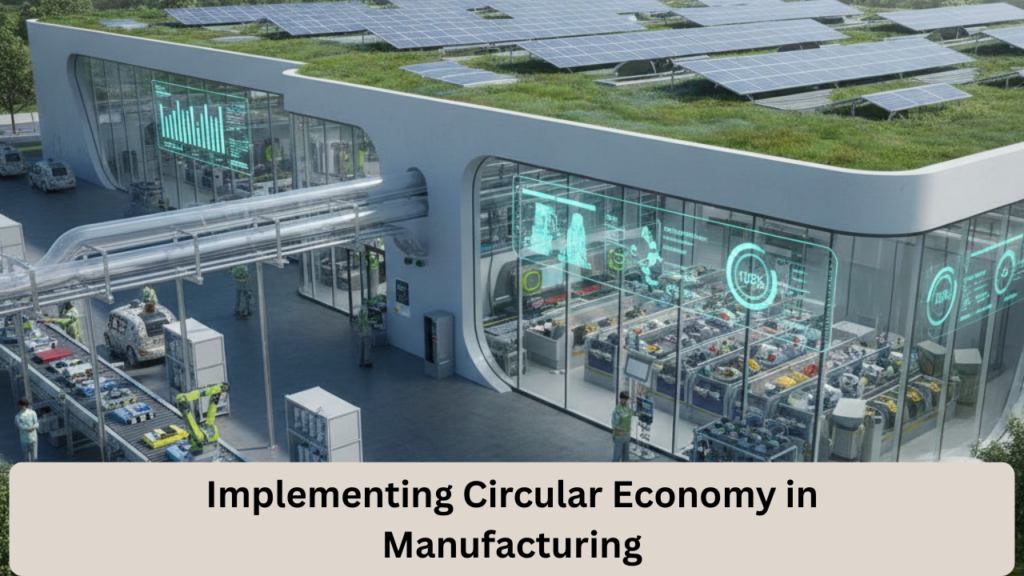
Implementing Circular Economy in Manufacturing. The beat of industry was not very long ago in a linear process: harvest materials in the earth, produce products, and dispose of rubbish. The take-make-waste model was the catalyst of progress over the centuries, but today the consequences of such a model are evident in the form of resources that are becoming depleted, landfills that are becoming filled to the brim, and a warming world.
Today there is a new, smarter rhythm that is emerging and it is transforming manufacturing from the bottom up. Circular economy is not merely a method to become more green; this is an entirely different mode of thinking about what the industry can be. It is transformation, the transformation from being a consumer of the world to a caretaker of the world. This transformation is helping things to operate better, generating new ideas, and gaining strength as never before.
The Real Meaning of the Circular Economy Beyond Recycling.
Imagine a beautiful and old-growth forest to make you understand the circular economy. No garbage truck will come to rake away the dead trees or fallen leaves. Implementing Circular Economy in Manufacturing. There is a reason for the endless process of coming and going in living. The dead trees are turned into the grounds where the saplings will grow, and the rotting leaves become a source of the soil. This is the natural brilliance that the objective of the circular economy aims to introduce into our factories.
To a manufacturer this will entail the elimination of the concept of waste. It is a systemic thinking approach that poses the question, how do we make this product last a lifetime or longer? But how shall we restore its parts to create a new one? It goes past the termination of recycling and is rather concerned with closed-loop systems wherein the material always treasured, utilized, and reused without going to a landfill.
Going in Circles Business Case.
The shift towards principles of circles is not only the right thing to do, but it is also the intelligent thing to do since giant forces are altering the world market.
The Efficiency Engine:
In a linear system, waste is expensive since you will spend money on raw materials that you do not utilize to the fullest and then you spend money once more to dispose of them. Implementing Circular Economy in Manufacturing. An ecological viewpoint of the waste considers it as a great waste of resources.
When companies plan their waste and identify the use of byproducts, they save their production expenses by a vast amount. As an example, a furniture company that uses 3D printing to create things with virtually negligible waste, or an auto plant that recycles metal shavings into using them to create new parts, is converting a cost center into a profit center.
The Supply Chain Shield:
There are limited resources in our world and markets that evolve swiftly. In such cases, the business can be easily influenced by the rise of prices, geopolitical conflicts, and resource shortages when it requires virgin materials. These types of issues defended against by a circular paradigm that puts recycled and repurposed resources first. It transforms an illegal supply chain of a company into a supply chain that is strong and localized.
The Innovation Catalyst:
Constraints will make individuals be more creative. When a design group is instructed to create a product that can easily be disassembled, repaired, and modified, it makes them creative. Implementing Circular Economy in Manufacturing. Such a mindset can result in new ideas of huge proportions, such as modular cellphones, leasing services for industrial equipment, and new materials created out of agricultural waste.
The Trust Builder:
More companies are becoming increasingly customer-principle-investor-top-talent-choosing. A manufacturer who has an actual, built-in circular approach is not merely selling a product; he or she is selling a lifestyle. This will result in high brand loyalty and trust and the organization will be a pioneer in a new era.
The Plan of a Circular Transition of the Manufacturer.
The transformation of a linear model into a circular model is not a switch. It must be carried out step-by-step and deliberately.
The Audit:
Become a Material Detective. The initial step that you should take is to know your own metabolism. It is like a check-up of your business when a full audit implemented on your materials and trash. It involves monitoring all the grams of material that enter into the production and their location. This little, yet significant, job reveals some behind-the-scenes currents of waste and inefficiency, providing us with a clear point of focus and a way out of how to proceed with it.
Design with the End in mind:
Circular by Design. The unmade waste is the most powerful. It is here that the drafting board begins to make it circular. Manufacturers are currently designing to:
Disassembly:
It is easy to remove a product that has been assembled with screws and standardized parts and cleanly separate the materials to reuse them when the product no longer of use. Enhance the Production Process of Make the Beating Heart. Then, have a glimpse of the product manufacturing process. Lean manufacturing and others help get rid of waste and make things more efficient. 3D printing or additive manufacturing, creates things by laying on a material one layer at a time.
The Supply Chain:
Learning to Spin a Circular Web. Without other things, a business cannot be circular. This involves collaboration with suppliers to locate environmentally friendly or recycled materials and with the customers to reclaim things when they become useless. It may involve replacement of selling things with selling services. An example is that you can lease lights to a business rather than selling light bulbs; this would allow you to retain the materials used as well as the incentive to make them last.
Develop a Circular Culture:
Engage Your People The successful implementation of a strategy relies on the person(s) who are to put it to practice since it is the people who make a strategy work. Through training and incentive programs you can make sure that every employee, line worker, engineer, sales team, is practicing circularly. People, who deal with the working processes and products every day, tend to best informed and have the most creative ideas.
Conclusion
The list of positive elements of such change exceeds the cleaner world significantly. The benefits of using the circular economy in companies are that they become more adaptable, resilient, and resourceful. Meanwhile, they reduce their expenses and their effects on the environment.
The practices allow businesses to succeed in future resource crises and changing regulations. In this regard, the circular economy is one of the most significant architectures of the 21st century, which requires creators and companies to be more inventive, productive, and innovative.
It is a transformation from being a past-time miner into a future-time gardener, whose value is not creation through consumption but constant re-creation of the planet. The circular model is not a choice every manufacturer should make whenever it wants not only to survive but also to flourish in the years to come. The only loop worth being in is it.