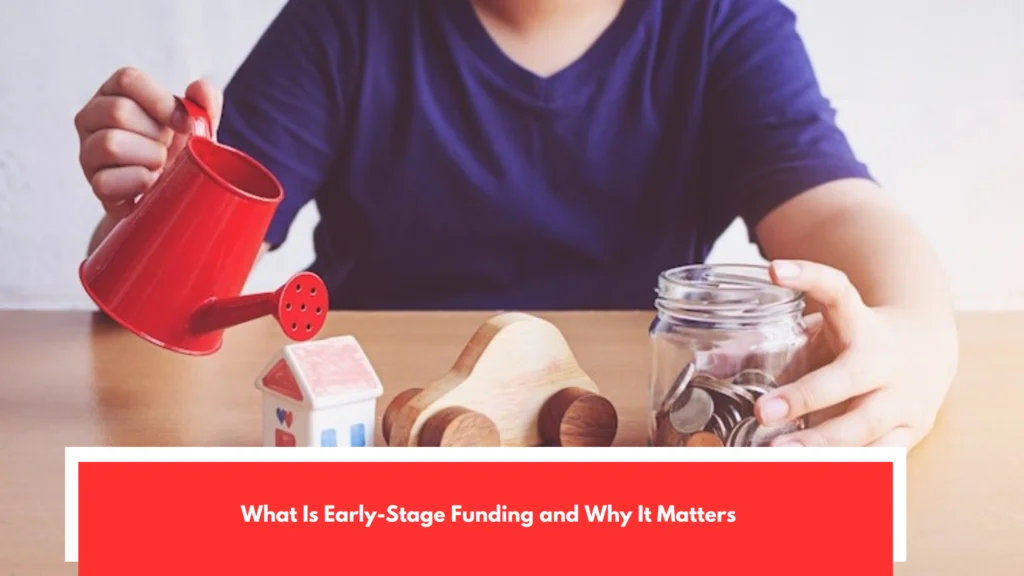
Seed funding seed funding The initial capital investment into a Software-as-a-Service (SaaS) company is referred to as initial funding and should help in paying operating expenses and expand operations once the Minimum Viable Product (MVP) has been proved. SaaS startups invest the initial money to optimize their product, build early subscription revenue, and prove their business model’s scalability. This is often supported by early-stage funding—what is early-stage funding? It’s the initial capital that helps startups grow from idea to traction.
Since SaaS companies have unique finance requirements based on the nature of the business model, during the early-stage funding is often accompanied by convertible debt so as to delay the formal valuation process until the growth path is more established in the company. It gives the tools of product development and market fit analysis which can impact the outcome.
Why Do You Need Funding?

With the rising popularity of such methods among investors, founders have to be ready to wait longer and need to make capital efficiency their priority. Small amounts of investments such as pre-seed funding are common in the pre-seed stage when companies begin to earn recurring revenue, although larger amounts of money are used to achieve intermediary milestones.
Pre-seed capital is important in early product development so that the SaaS company has a base to build upon before approaching bigger investors. SaaS seed capital usually lies somewhere between 1 and 4 million dollars signifying the level of growth and valuation of the startup. Angel level seeds are on average about $150,000 and VC led seeds range in average at around 1.5 million.
How Can You Prepare?
MRR The average amount before SaaS startups raise a VC round is somewhere around $5 to 25 thousand. To allow an opportunity of defraying operational expenses within the initial six to twelve months, startups ought to raise adequate seed capital that would meet their special needs and milestones. 24 to 36 months runway is advisable to shield the SaaS companies against the funding wait and economic issues. Due to this runway increase, this will allow startups to concentrate on gaining longer-term growth as well as gaining product-market fitting.
The reason of long runway is that it stimulates more planful and less reactive way of corporate development because it reduces the short-term financial strain. With current tightening fundraising conditions, this transition to a longer runway, in contrast to the past 18-24 months, is more important to the long term survival. The key metrics that seed investors in SaaS look at are Total Addressable Market (TAM), Recurring Revenue Growth Rate, Customer Acquisition Cost (CAC), and LTV: CAC Ratio. Once considering the long-term viability of a start-up, those parameters are necessary to understand its likelihood of targeting the market and fit into a product.
How Funding Works

In the case of SaaS companies having annual recurring revenue (ARR) under $1 million, the rate of growth of recurring revenue is highly significant since it shows traction at an early stage. Facts like: LTV/CAC ratio is low, the revenues per customer are low, or EPS are negative maybe relevant to the notion that scalability applies to a company. Founders in the majority of SaaS startup funding plants lose between 10-20 % of the business.
Founders ought not to sell more than 30 percent of equity of a business during a seed round to ensure that they always have the freedom to maneuver in the future. During seed round the ownership of the founders of the SaaS business reduces. This may alter their decision-making powers and have something to do with their share in future dividends. When founders sell a percentage of 10-20 percent in a seed funding, it leads to the continuous dilution.
Conclusion

It is important not to lose majority ownership after seed round and at least 50 percent after the Series A and the way to do this is to apply methods that block dilution to acquire an adequate amount of money since too much dilution can be demoralizing to the founders and execution can be hampered. Begin by assessing performance track records and experience of the prospective investors in the SaaS industry. Assess the assets and infrastructure they offer concerning the growth in the size of your business in the future. Make sure that their priorities, values, and investment.
As an example, use websites such as Crunchbase or Visible Connect to find investors that were previously investing in similar SaaS startups. Considering angel investors and incubators/accelerators may help when you are at an early seed funding phase, and your target is very similar. Making an announcement of seed funding is a strategic move that a SaaS startup can make, which has prosperities and drawbacks.