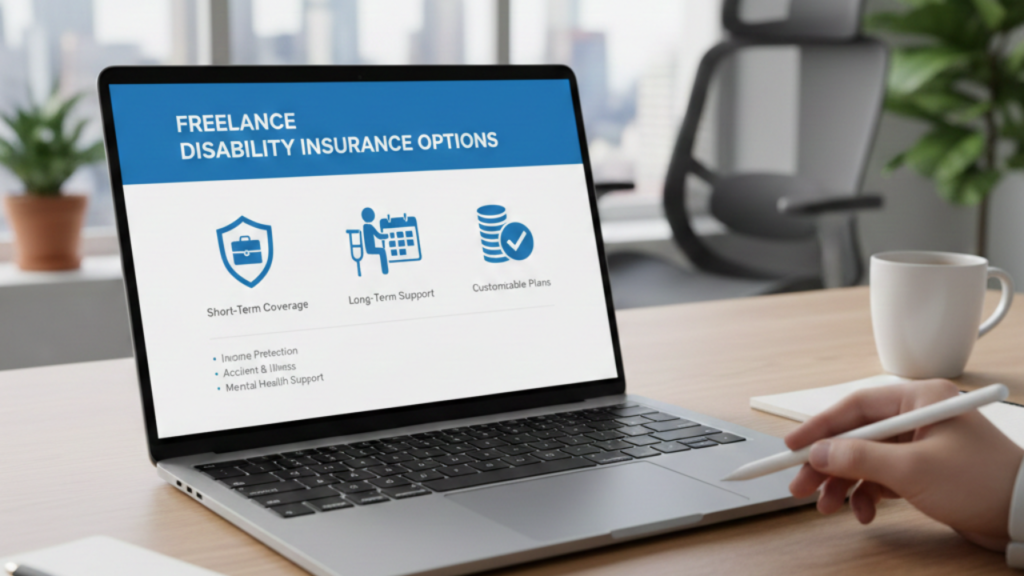
Freelance Disability Insurance Options. The freelancers enjoy the liberty and adaptability in their work life as compared to any other. They have the liberty to do their own schedules, choose their workmates, and pursue their aspirations. There are dangers to this freedom, however, and in particular to securing your income. The freelancers do not enjoy employer-sponsored disability insurance as the regular employees do.
Their earnings might be immediately stopped case they fall ill or injured and in capable of working. This is where disability insurance comes in. It can be of great financial insurance to individuals who work independently in the event that they are unable to work. Freelancers can safeguard their lives by understanding the available insurance options, their prices, and their requirements.
Which type of disability insurance is the best
Disability insurance is of two major types, namely short-term disability (STD) and long-term disability (LTD). They both can used to the benefit of the freelancers, but the one that provides long-term security is usually better. Short-term plans accommodate those disabilities that span from a few weeks up to months. Nevertheless, long-term disability cover is often more helpful to self-employed individuals, as it provides them with income when they are not able to work due to some long-term disability.
In the case that the individual with the long-term disability insurance fails to work, the insurance company usually pays the disabled a percentage of their salary, which is usually 50-70 percent. In this case, freelancers are certainly supposed to adopt a policy of their own occupation. Such coverage ensures that they paid benefits even in cases when they unable to perform their specialized job, even when they legally able to work in a different job.
Another coverage that is available to freelancers is the extra rider of residual disability coverage, which will see the freelancer partially compensated in case he/she can work but not as well as he/she did. Long-term fiscal security further reinforced by such riders as cost-of-living adjustments (COLA) and guaranteed renewability. Ultimately, the freelancers ought to have disability coverage, which must cover all and long-lasting with parameters that may be modified depending on their unforeseen and fluctuating incomes.
What is the cost of disability insurance among the self-employed
Disability insurance depends on the age, sex, work, earning status, health status, and kind of policy taken. In the case of the self-employed, the premiums may be a bit higher when compared to employer-sponsored plans since they will have to assume the entire amount themselves.
At an average rate, long-term disability coverage costs freelancers 1%-3% of their annual earnings. To illustrate, a freelancer who is earning a yearly income of $60,000 can pay an amount of $600 to $1,800 per year.
Additional cost determinants are
Benefit Amount and Duration
Increase in benefits monthly and payout leads to an increase in premiums. Disability protection until retirement age is more expensive and has better protection.
Elimination Period
This is the time to wait before benefits can received—usually 30, 60 or 90 days. The elimination period of 90 days can be of great benefit in terms of lowering the premium rates.
Occupational Risk
Physically demanding jobs (construction, photography, manual labor) will have higher premiums than sedentary or otherwise creative jobs (writing, design, consulting).
Are working people eligible to receive disability benefits
To receive disability payment, self-employed individuals must purchase the appropriate type of insurance, and they must join government disability programs. Disability benefits provided to freelancers, although they must plan advance to ensure that they are covered.
Individual Disability Insurance.
Disability income paid to most freelancers by the private insurance firms. They will be able to receive payment in case they make payments and fulfill what the policy demands in the event of disability. These plans the most protective since they grounded on your earnings and occupation.
Government-sponsored programs.
Independent workers can also receive some government-funded disability assistance, such as:
- Social Security Disability Insurance (SSDI) is available to freelancers in the U.S. provided that the person has sufficiently contributed to the Social Security program by paying taxes as a self-employed individual.
- In some countries, there is a national disability program, although this is based on the functioning of the social insurance system.
However, disability benefits provided by the government tend to contain harsh policies regarding who is eligible to get them and the time required to receive the state benefits. They frequently require to convinced that the individual has serious and permanent infirmities that do not allow him to work in any form, not limited to his usual occupation. Due to these restrictions, many freelancers use personal disability insurance to cover their lost income.
Freelancers and Professional Association Unions.
The unions, co-ops, and freelance associations provide group disability insurance in certain locations. Group plans are more affordable and straightforward to obtain and hence, they can used by independent workers.
Enhancing the financial security of Freelancing
Freelancers must learn to cope with issues that other individuals do not face in regard to the earning of their incomes. This is what makes disability insurance that significant portion of long-term financial planning. People not having the benefits of their work must take some measures to obtain the coverage that would cover their income in case they become ill or injured.
The most effective way to make freelancers resilient and peaceful is to select the right type of disability insurance, familiarize themselves with the costs, and consider their chances of becoming eligible. The right insurance would help self-employed people to establish a good financial basis, which would not only enable them to enjoy their freedom but also to attain a career horizon.